Noise complaint tool for airfields
Greater transparency for residents, structured assessment for airfields
Aircraft noise is perceived very differently. This makes a clear process all the more important: residents want to report what they have experienced easily and be able to see that their complaint is being reviewed. Airfields need reliable information and suitable flight data to assess possible causes objectively.
The noise complaint tool brings both sides together in a structured process – from the initial report and the preservation of relevant flight tracks through to the assessment of possible aircraft involved.
Simple, multilingual complaint submission
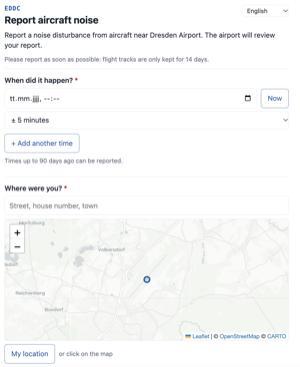
Each airfield can embed a public complaint form directly into its website. The form is available in 14 languages. The airfield activates the function itself; until it has been enabled, the form is not publicly accessible.
Residents can provide:
- up to five times at which they experienced aircraft noise,
- a precision window of between ±0 and ±60 minutes for each time; the default is ±5 minutes,
- the address at which the noise was experienced,
- a free-text description of the incident,
- their name and email address, with an optional telephone number.
The reported times may be no more than 90 days in the past. The address is positioned on a map for the assessment and must be no more than 30 kilometres from the airfield. Consent to the processing of the information provided is required before the form can be submitted.
Protection against misuse and secure confirmation
A CAPTCHA and fixed submission limits protect the form against misuse. A maximum of three reports per email address and ten per IP address can be submitted each day. Contact details are stored in encrypted form.
After submitting the form, the person making the report receives an email containing a confirmation link. This message is available in German, English and French. For all other form languages, it is sent in English.
The complaint is only considered received once the confirmation link has been clicked. If it is not confirmed within 48 hours, the unconfirmed report is deleted automatically.
Relevant flight tracks are preserved automatically
The system continuously records available flight tracks from OGN and Jetvision for participating airfields. Under normal operating conditions, this data is deleted after 14 days.
Once a complaint has been confirmed, the relevant flight tracks around the reported time windows are retained for six months. The retention period is extended for as long as the case remains open. This ensures that the information required for the review remains available even if the complaint is processed later.
Structured assessment in GAT
Authorised staff can find incoming complaints in GAT under Applications → Noise complaints. Separate read and write permissions determine who can view or process the cases.
A counter indicates new complaints. The link to the public form and the iframe code for embedding it into the airfield website are also available directly from the overview.
In the individual case view, the system automatically searches for aircraft that may have been involved in the reported incident. It considers the specified time window plus an additional five-minute buffer.
For each potential candidate, the system displays:
- the time of its closest approach,
- its horizontal distance from the reported location,
- its altitude,
- the direct three-dimensional distance, and
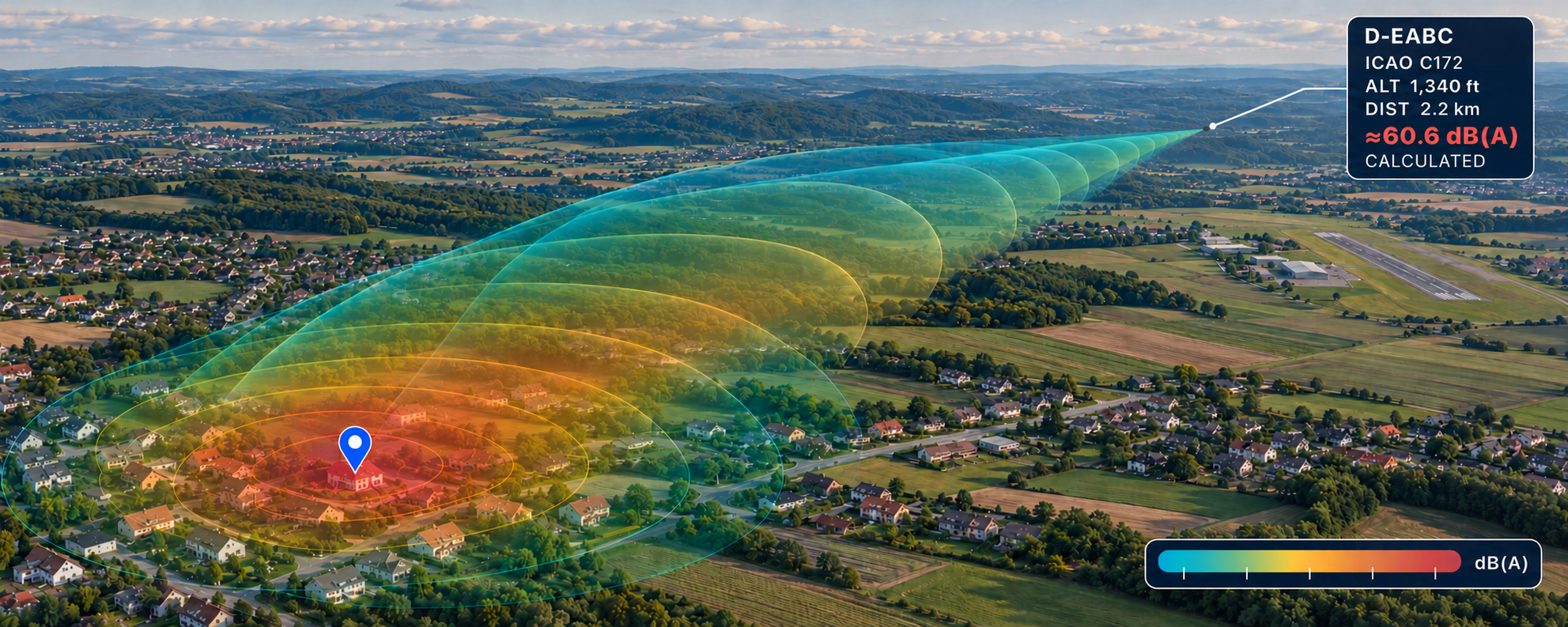
- the calculated estimate of the noise level at the residential address in dB(A).
How the noise level is estimated
The calculation is based on the certified value in the aircraft’s noise certificate. If no noise certificate is available, the system uses an approximate value based on the aircraft’s maximum take-off weight or aircraft type.
The level is then adjusted according to the distance from the reported location. The airfield’s METAR weather data is also taken into account, including whether the reported location lies downwind or upwind.
Up to 15 candidates with the highest estimated noise levels are displayed.
Local traffic, overflight or special operation?
The system also carries out an automatic preliminary classification:
- Local traffic: The aircraft appears in the flight log within ±20 minutes or was detected at the airfield by radio or from its flight track.
- Overflight: The aircraft is classified as third-party traffic.
- Rescue or military: A corresponding operation is identified from the call sign or transponder identifier.
This classification assists with processing the complaint but does not determine the final assessment.
Heatmap for geographical context
An additional map view visualises the estimated maximum level within a three-kilometre radius of the reported residential address. The heatmap is calculated from the five strongest candidates and makes the geographical context easier to understand.
Guidance, not a noise measurement
The levels and classifications shown are calculated indicators. They do not replace a sound measurement and do not automatically prove that a particular aircraft caused the reported noise. The airfield reviews the case and makes the final assessment.
This creates a traceable process for both sides: residents receive a clear and reliable reporting channel, while airfields can review complaints using a broader data base and provide more understandable responses. This supports an objective dialogue and can contribute to greater trust and acceptance in the area surrounding the airfield.
Relevant aerops solutions
Learn more about the solutions for your airfield: AMS Basic and AMS Enterprise.
Interested in the noise complaint tool? Talk to us.