Automatically Record Takeoffs and Landings
Using aviation radio and flight-track data—even when no one is on site
Automatic flight movement detection
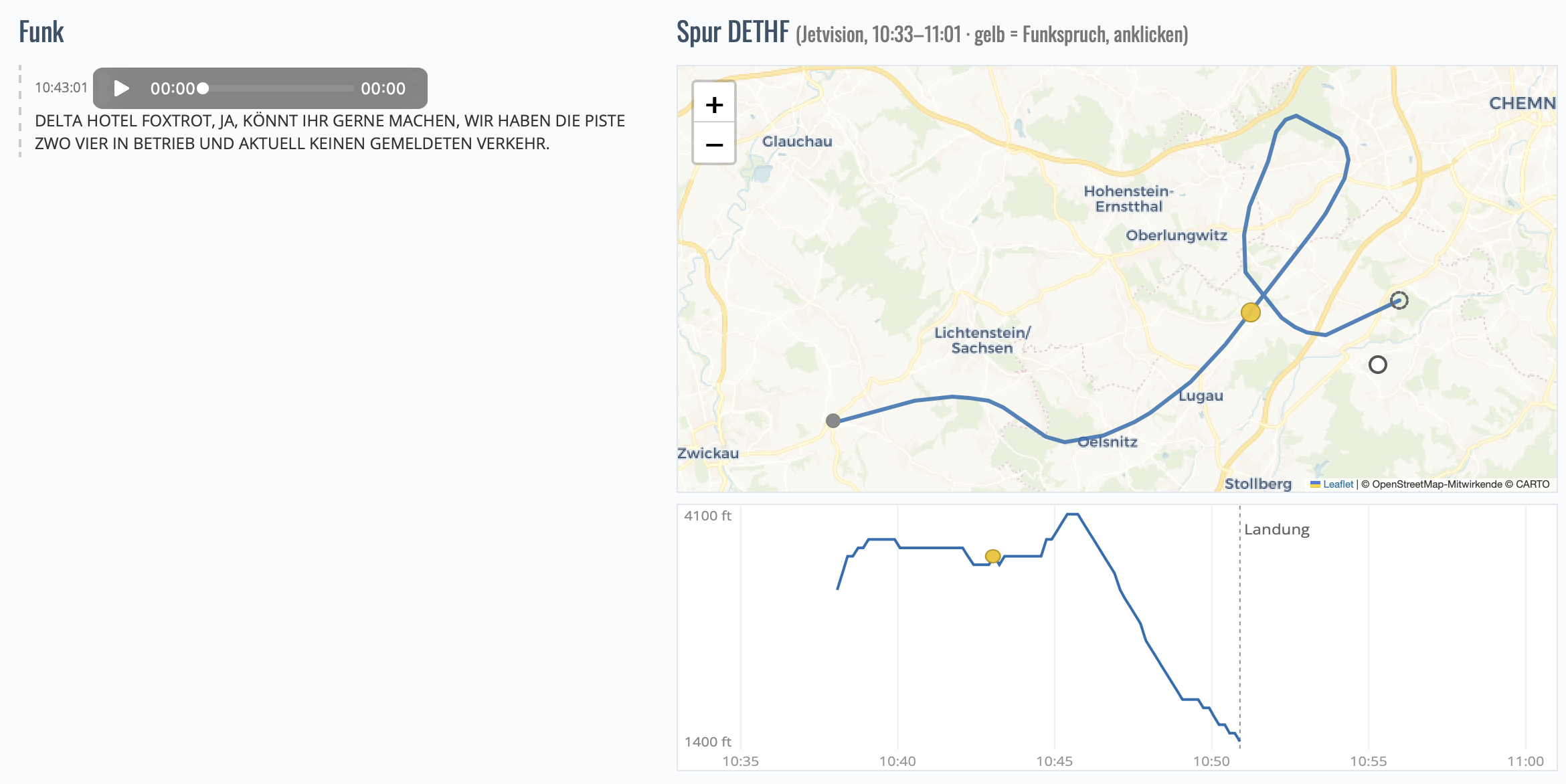
aerops combines transcribed aviation radio communications with ADS-B, FLARM and MLAT data. This makes it possible to capture aircraft movements outside staffed operating hours, document them in the official aircraft movement log and make them available for billing.
- Fewer gaps in the aircraft movement log
- Minimal installation effort
- Automated billing of airfield fees
- German and English aviation radio recognition
When self-reporting is not enough
At smaller airfields, operational staff are often only available for limited periods—or not on site at all. At the same time, depending on the applicable regulations, takeoffs and landings must be fully documented and correctly assigned for the official aircraft movement log and billing.
With the aerops Pilot App and its integrated payment system, pilots can report their aircraft movement and pay directly in just a few clicks. However, even a simple process is occasionally forgotten. This results in gaps in the aircraft movement log, additional research and unbilled aircraft movements.
Detection technologies
Why individual detection technologies reach their limits
ADS-B and FLARM
ADS-B and FLARM signals provide valuable position data. However, not every aircraft is equipped with the relevant technology. If no compatible device is active or radio coverage ends, no usable position data are available from that source.
Multilateration
Aircraft equipped with an active Mode S transponder can also be located without transmitting an ADS-B position by using multilateration, or MLAT. A standalone local setup requires several receivers at suitable locations around the airfield.
Achieving coverage all the way to the ground often requires sites with suitable power and internet connections, which can be difficult to find. Barometric altitude data, QNH, airfield elevation and the flight profile must also be evaluated together to distinguish a genuine landing from a low pass, for example.
When an existing MLAT network is used, an additional receiver at the airfield can improve local coverage.
Camera systems
Camera-based systems provide visual documentation and can also show other activity taking place at the airfield. Modern lenses and recognition technologies now deliver very good results.
However, cameras require a suitable mounting location with an unobstructed view, a reliable power and data connection, and regular maintenance. Installation can therefore be particularly demanding at the locations where coverage is most important.
The aerops solution
Intelligently combining radio and flight-track data
Our freely available Raspberry Pi project, OpenRadio, can receive aviation radio communications at the airfield using an RTL-SDR dongle or the audio interface of a radio transceiver.
The highly compressed audio stream is transmitted to the aerops server and transcribed automatically. The model currently supports German and English aviation radio communications and achieves a recognition rate of around 70%.
When combined with a receiver at the airfield and data from an existing MLAT network—such as jetvision—it provides a considerably more complete picture of aircraft movements.
When the track ends, radio completes the picture
If MLAT coverage ends at low altitude, a reliable position track may no longer be available for the final part of the flight.
aerops therefore combines the last available track—including the descent or climb profile and the arrival or departure direction—with the transcribed radio calls. This makes it possible to assign takeoffs and landings more reliably than with a single data source.
Automatically documented and billed
Detected aircraft movements are documented in the aerops aircraft movement log together with the associated track and radio information. Where the relevant data are available, the system adds the departure and destination airfields using the pan-European aerops airfield network.
The aircraft movement can then be transferred directly to billing. The associated audio files are deleted automatically after seven days.
If required, a camera system can be added as an additional data source.
Available with aerops AMS Basic
Automatic aircraft movement detection is already available with aerops AMS Basic.
Do you need aviation radio recognition in another language? Get in touch—we will be happy to train the model together with you.